


- 20 April 2026
- By: Edge Admin
- in: Information

Have you ever wondered why one week in the UK can be filled with endless rain and wind, while the next is surprisingly warm and sunny? The answer often lies miles above your head, in a powerful, high-altitude wind known as the jet stream.
At Edgehire4homes, we are obsessed with understanding the weather because we know how directly it impacts your home. Whether it’s the need for a dehumidifier after a heavy downpour or an air scrubber to tackle mould spores after a damp spell, the jet stream is the invisible hand guiding it all.
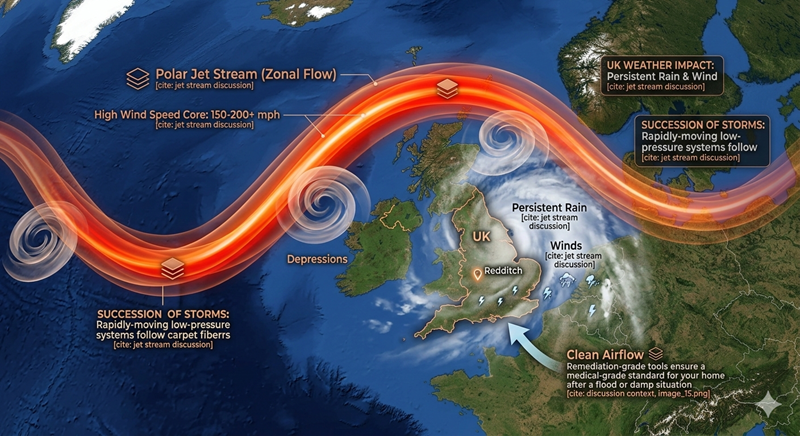
Think of the jet stream as a fast-flowing ribbon of air circling the globe, high up in the atmosphere. It is created by the dramatic temperature difference between cold polar air and warm tropical air. The “Polar Jet Stream,” which sits right over the UK, is the primary driver of our weather.
The jet stream doesn’t just sit still; it “meanders” like a massive river. The shape and position of these meanders determine whether you’ll need a raincoat or sunglasses:
When the jet stream dips far to the south of the UK, it creates a “trough.” This positioning pulls cold, unsettled air and Atlantic low-pressure systems directly towards us. This is the classic recipe for typical UK weather:
Widespread rain: Often continuous and heavy, leading to a surge in demand for industrial dehumidifiers.
Strong winds: Blustery conditions that can unfortunately cause storm damage.
Colder temperatures: Feeling much chillier than average.
Conversely, when the jet stream bulges far to the north of the UK, it is called a “ridge.” This pushes the wet, windy weather systems away, allowing warm, stable air to build up over the country. This results in:
Sunny skies: Often with very little cloud cover.
Higher temperatures: Leading to summer heatwaves or milder winter days.
Dry conditions: Great for outdoor projects, but can sometimes lead to very dry indoor air.
A wavy, slow-moving jet stream can create “blocked” weather patterns. This means a period of heavy rain can get stuck over the UK for weeks, leading to serious flooding and water damage.
That’s why we monitor these high-altitude winds. When we see a deep trough forming and getting stuck, we know that homeowners in the UK might soon be facing damp, mould, or flood challenges.
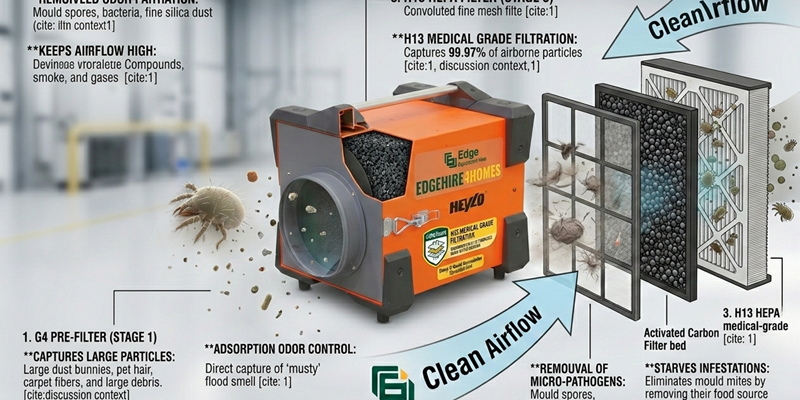
Whatever the jet stream throws at you, Edgehire4homes is here with the professional-grade tools you need to protect your property. From medical-grade H13 HEPA air scrubbers to remove airborne contaminants after a damp spell, to the DrizAir industrial dehumidifiers for rapid water removal, our “Healthy Home” standard ensures you are prepared.
A great site to see the jet stream in action
To create very wet weather in the UK, the jet stream typically takes one of two specific positions: running directly over the UK or dipping south of the UK.
When the jet stream is in these positions, it acts like a high-altitude conveyor belt, steering Atlantic low-pressure systems (depressions) straight toward the British Isles.
If the jet stream sits directly above the UK in a relatively straight line from west to east, it creates a “zonal flow.”
The Result: A constant succession of Atlantic storms.
Weather Impact: This brings fast-moving, persistent bands of rain and strong winds. It is often the cause of “washout” seasons where one storm follows another every few days.
When the jet stream “buckles” and loops southward, it creates what meteorologists call a trough.
The Result: Low-pressure systems become “trapped” over the UK.
Weather Impact: Because the jet stream has moved south, the UK sits on its “cold” northern side. This often leads to slow-moving or stationary weather patterns. If a rain band stalls over the country, it can result in extreme rainfall and flooding, as seen in the infamously wet summer of 2012.
| Jet Stream Position | Typical UK Weather | Likelihood of Flooding |
| North of UK | Warm, settled, dry (High Pressure) | Low |
| Directly Over UK | Windy, frequent rain spells | Moderate (Succession of storms) |
| South of UK | Very wet, cold, slow-moving rain | High (Stalled low pressure) |
The jet stream doesn’t just steer rain; it can actually intensify it. It acts like a giant atmospheric vacuum cleaner—sucking air up from the surface. This rising air cools and condenses, creating the thick clouds and heavy rain associated with deep low-pressure systems.


We specialise in hiring modern, reliable equipment delivered straight to your door, by our people, in our vehicles.