


- 2 March 2026
- By: Edge Admin
- in: News

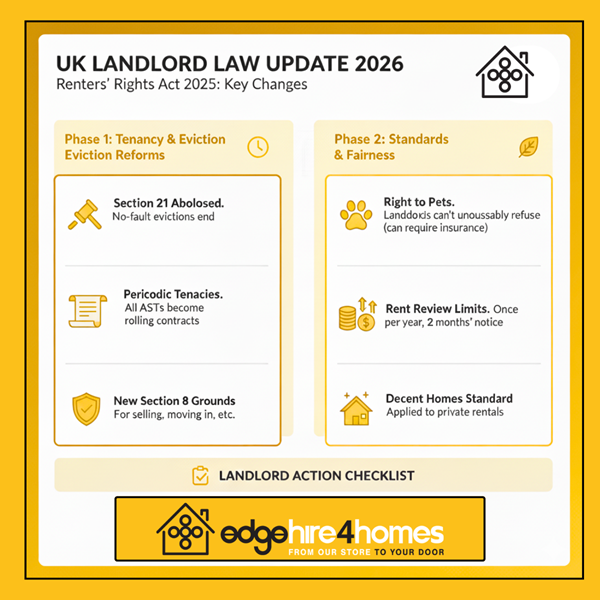
Originally part of the Social Housing Regulation Act, Awaab’s Law now applies to the Private Rented Sector. It mandates that landlords must:
Investigate hazards (like damp and mould) within 14 days.
Start repairs within a further 7 days if the hazard affects health.
Complete emergency repairs within 24 hours.
For a private landlord, “opening a window” is no longer a legal defence. You need a documented, professional drying strategy.
Most landlords fail compliance because they only treat the surface mould. Awaab’s Law requires the removal of the hazard. If moisture is trapped in the sub-floor or wall cavities (what we call Scenario B), the mould will return, and the landlord remains legally liable.
By hiring an Adsorption Dryer or high-performance Refrigerant Dehumidifiers from Edgehire4homes, you create a “paper trail” of professional remediation.
To protect your investment and your tenants, follow this 3-step response plan:
Step 1: Scientific Assessment (Day 1-3) Don’t just look at the mould. Use professional moisture meters to find the source. Is it a “Scenario A” leak or “Scenario B” structural damp?
Step 2: Active Extraction (Day 3-10) Install professional-grade drying equipment. Our HEPA H13 Air Scrubbers capture 99.97% of mould spores, immediately improving the tenant’s “Healthy Home” environment while repairs are underway.
Local Support Across the UK
With depots in Livingston, Runcorn, Stoke, Redditch, Watford, and Portsmouth, Edgehire4homes provides the rapid response required by Awaab’s Law. We can have industrial drying equipment at a rental property in under 4 hours, ensuring you meet the 24-hour emergency window.
For the comprehensive details see The Governments page
At Hire4Homes, we help landlords, housing associations and managing agents respond quickly by supplying professional air purification equipment that improves indoor air quality while investigations and repairs are carried out.

We specialise in hiring modern, reliable equipment delivered straight to your door, by our people, in our vehicles.