


- 10 June 2026
- By: Edge Admin
- in: Information

Many commercial facilities and eco-conscious homeowners look at traditional air conditioning (AC) bills and ask the same question: Is there a cleaner way to cool a building without standard, high-carbon refrigeration?
As an alternative, evaporative cooling (often called adiabatic cooling) claims to offer up to 90% energy savings. But does the math actually hold up when you factor in water usage, or is it just greenwashing?
Below is a first-hand engineering and sustainability audit of evaporative coolers, their net carbon impact, and how to calculate if they will actually work in your specific space.
Traditional air conditioning relies on a closed chemical loop. A high-wattage compressor forces refrigerants (like R-32 or old HFCs) to change states, absorbing indoor heat and dumping it outside. It is an energy-intensive process that leaves indoor air feeling dry and stale.
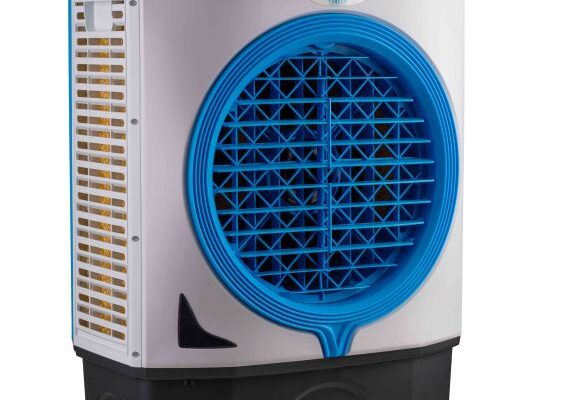
Evaporative cooling uses adiabatic cooling—a natural physics process where sensible heat in the air is absorbed by water as it converts into vapour.
[Outdoor Air: Hot & Dry] ---> [Saturated Cellulose Media Pads] ---> [Indoor Air: Cool & Fresh]
                                      ▲
                                 [Water Pump]
Because the phase change happens naturally, the machine only uses electricity to power two components:
A small, low-voltage water pump to keep the pads wet.
An axial or centrifugal fan to move the air.
Because there is no compressor, the power drop is massive.
[Check Availability & Book Your Evaporative Cooler]
To see how this affects your carbon footprint, let’s look at a side-by-side energy profile for cooling a standard $100\text{ m}^2$ commercial workspace or large open room over an 8-hour operating shift.
| Metric | Traditional Refrigerated AC | Evaporative Cooling Unit | Net Green Benefit |
| Average Power Draw | 3.5kw – 5kw | 0.4kW – 0.7kW | ~85% reduction in power |
| Daily Electricity Used | 32 kWh | 4.8kWh | Saves 27.2kWh daily |
| Chemical Refrigerants | Yes (High GWP Potential) | None (Pure Water) | Zero toxic leak risk |
| Air Source | Recirculated (Stale) | 100% Fresh Air | Continuous air changes |
The Power Station Water Paradox: Critics often point out that evaporative coolers consume water (roughly 10 to 20 litres per hour depending on humidity). However, fossil-fuel and nuclear power stations use massive amounts of water purely to cool their generation turbines. Because an evaporative cooler saves so much electricity, it often saves more water at the grid level than it consumes out of your local tap.
If you are looking to install or hire an evaporative cooler, you cannot size it like a standard AC unit (which uses BTU or kW ratings). Instead, you must calculate the CFM (Cubic Feet per Minute) or air changes per hour.
To find the exact size unit your space needs for sustainable cooling, use this standard volumetric formula:
If you have a workshop or deep living space that is 40 feet long, 25 feet wide, and has 10-foot ceilings:
For this space, you would need an evaporative cooler rated for at least 5,000 CFM. Buying anything smaller will result in stagnant, overly humid air.
Evaporative cooling is not a universal fix. Because the cooling relies entirely on water turning into gas, its efficiency drops off sharply as the ambient relative humidity (RH) rises.
Below 40% RH: Ideal performance. Can drop incoming air temperatures by up to 10 degrees C to 15 degrees C.
40% to 60% RH: Moderate performance. Expected temperature drop of 5 degrees C to 8 degrees C.
Above 65% RH: Ineffective. The air is already too saturated to accept more water vapour. The unit will simply act as a fan while raising the indoor humidity to uncomfortable levels.
For UK installations, this means evaporative cooling is an incredible, ultra-green choice for high-heat commercial settings (like data centres, bakeries, or laundries) and hot, dry summer days. However, it is poorly suited for coastal, naturally humid environments.

We specialise in hiring modern, reliable equipment delivered straight to your door, by our people, in our vehicles.