


- 20 April 2026
- By: Edge Admin
- in: Information


On a UK construction or renovation site, a HEPA (High-Efficiency Particulate Air) machine—often called an Air Scrubber—is the difference between a managed workspace and a hazardous one.
While a dehumidifier removes water, a HEPA machine removes invisible killers from the air. Under UK COSHH (Control of Substances Hazardous to Health) regulations, managing site dust is a legal requirement, not an optional extra.
Here are the primary benefits of using a HEPA-grade air quality machine on-site.
The biggest risk on UK sites is RCS (Respirable Crystalline Silica). When you cut brick, stone, or concrete, it creates a fine dust.
The Danger: The particles you can’t see are the ones that travel deep into the lungs, leading to silicosis or COPD.
The HEPA Benefit: A “True HEPA” filter (H13 or H14 grade) captures 99.97% of particles down to 0.3 microns. It pulls these microscopic hazards out of the air before workers or clients can breathe them in.
The Health and Safety Executive (HSE) frequently runs “Dust Kills” inspections across the UK.
Fines: Companies can face significant fines (often exceeding £2,000 per instance) for failing to control dust at the source.
Evidence of Care: Having a HEPA air scrubber running provides tangible proof that you are following the “Assess, Control, Review” model required by law.
One of the most powerful features of an HP air scrubber is the ability to attach ducting. By venting the cleaned air outside of the work area (e.g., through a window or vent), the machine creates a slight vacuum in the room.
If you are working in a lived-in property or a sensitive commercial space (like a hospital or office), you cannot let dust migrate to other rooms.
How it works: You can duct the HEPA machine to vent “clean” air outside the room. This creates negative pressure, meaning air is sucked into the work zone but cannot leak out through door gaps or vents.
The Result: The rest of the building stays pristine, saving you hours of “snagging” and cleaning at the end of the job.
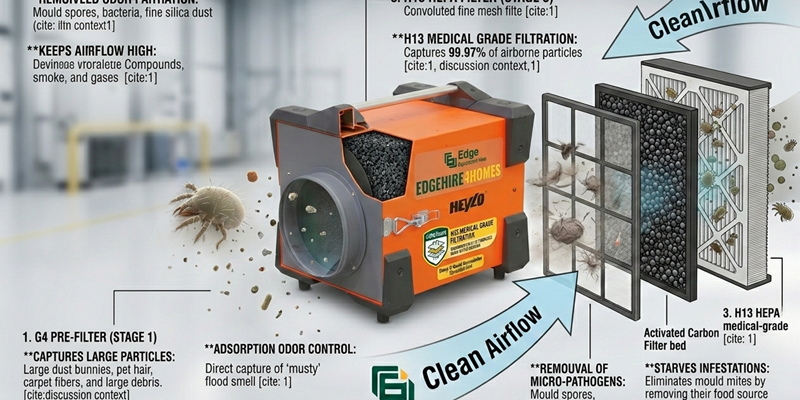
Many professional HEPA units can incorporate a Carbon Pre-filter.
Fumes: This is essential when using floor resins, solvent-based paints, or adhesives that give off strong VOCs (Volatile Organic Compounds).
Client Comfort: It removes the “chemical smell” of a renovation, making the site much more bearable for occupants.
High Air Change Rates (ACH)
Professional “HP” units are rated by their CADR (Clean Air Delivery Rate). For a standard UK renovation, the Health and Safety Executive (HSE) guidelines suggest high air exchange to keep respirable dust below workplace exposure limits (WELs).
The Math: A high-performance unit can provide 6 to 12 air changes per hour. This means every bit of air in the room is scrubbed clean every 5 to 10 minutes.
Hire Advantage: You can hire a unit specifically sized for the room’s volume (Length x Width x Height), ensuring you aren’t under-powered.
HP air scrubbers don’t just use one filter; they use a “filtration sandwich”:
G4 Pre-filter: Catches large drywall and sawdust (extending the life of the expensive filters).
Carbon Filter (Optional): Adsorbs VOCs, paint fumes, and the “musty” smell of damp or fire damage.
H13/H14 HEPA Filter: The final barrier that traps 99.97% of microscopic particulates.
| Feature | Why Hire an Hepa Unit? | The “Buying” Reality |
| Filter Costs | You start with fresh, certified filters for every job. | HEPA filters are expensive (£80–£150) and often get “clogged” and forgotten. |
| Site Safety | Most hire units are 110V, meeting UK site safety requirements. | Many retail units are 230V only, requiring transformers on-site. |
| Testing | Units are PAT tested and flow-rate checked before hire. | Performance degrades over time without specialist maintenance. |
| Versatility | Hire a small unit for a bathroom; a massive one for a warehouse. | You are stuck with one size that may be too weak or too bulky. |
| Feature | HEPA Air Scrubber | Standard “M-Class” Vacuum |
| Primary Job | Cleans the ambient air in the room. | Extracts dust at the tool (the source). |
| Operation | Runs continuously while you work. | Runs only when the tool is on. |
| Benefit | Caters for “disturbed” dust from sweeping. | Only catches what the shroud collects. |
| Requirement | Essential for unventilated UK basements. | Mandatory for all power-tool cutting. |
If you are working on a project involving asbestos (pre-2000 builds) or lead paint, a standard HEPA hire is not enough. You legally require H-Class (High Hazard) equipment and, in many cases, a licensed professional to manage the filtration.


We specialise in hiring modern, reliable equipment delivered straight to your door, by our people, in our vehicles.