


- 20 April 2026
- By: Edge Admin
- in: Information

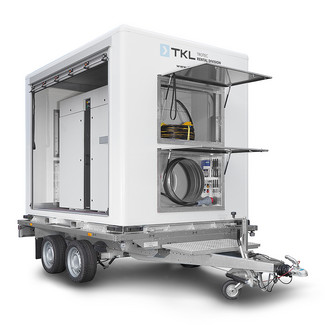
Trailer-mounted units are the “heavy artillery” of the restoration world. They are essentially massive, weather-proof drying plants on wheels that can do the work of 30 to 50 standard dehumidifiers while using a fraction of the power.
For Edgehire4homes, understanding these is key to handling major renovations or large flood losses. Here are the three main types of trailer drying units used in the UK:
These are the most common for high-performance drying, especially in the UK’s often cold and damp climate.
How they work: They use a rotating desiccant wheel (usually silica gel) that “soaks up” moisture directly from the air like a sponge.
The “Edge” Advantage: Units like the TTR 5200 available through Edge Equipment Hire can extract over 1,100 litres of water per day and move up to 8,200 $m^3/h$ of dry air.
Best For: Deep structural drying, cold environments (working down to $-10^\circ C$), and large commercial spaces.
These units focus on using massive amounts of heat to “drive” moisture out of building materials.
How they work: They use a furnace (often powered by diesel or LPG) to heat air. Crucially, the combustion gases are vented outside, while only clean, dry, hot air is ducted into the building.
Why it’s fast: By warming the structure itself, you increase the vapour pressure within the materials, forcing moisture to evaporate much faster than it would at room temperature.
Best For: Rapid “speed drying” in construction (drying screed or plaster) and sanitising buildings by using heat to kill pathogens without chemicals.
Often integrated into the trailers mentioned above, these systems focus on the movement of air.
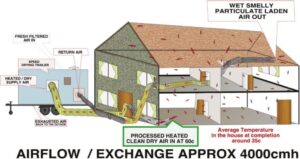
How they work: The trailer “over-pressurises” the building with hot, bone-dry air. This forces the damp, heavy air out through natural gaps in the structure (windows, vents, or eaves).
Efficiency: Some modern systems, like the Speedry trailers, are incredibly green, running off a single 13-amp plug while managing the drying of three adjoining properties simultaneously.
| Feature | Portable Dehumidifier | Trailer Drying Unit |
| Capacity | 20–100 Litres/Day | 500–1,200+ Litres/Day |
| Performance in Cold | Poor (below $15^\circ C$) | Excellent (down to $-10^\circ C$) |
| Setup Time | Instant | Requires ducting & 3-phase power (usually) |
| Cost Efficiency | High for single rooms | Far cheaper for large/complex buildings |
Traditional refrigerant dehumidifiers struggle in typical UK conditions (12 degrees). A machine rated for 60 litres a day often extracts less than 24 litres when put to work in a real-world damp environment.
Speedry changes the game:
50x the Power: One Speedry trailer can do the work of up to 50 standard dehumidifiers.
13-Amp Efficiency: Amazingly, the entire system can run from a single 13-amp or 110v socket, whereas dozens of dehumidifiers would overwhelm a building’s power supply.
90% Faster Drying: By using controlled heat and massive airflow, Speedry can cut drying times by up to 90% compared to traditional methods.
All-Weather Performance: While standard units fail in the cold, Speedry creates a “perfect drying day” inside your property, whether it’s snowing outside or a humid summer.
Speedry doesn’t just “suck” moisture; it manages the entire environment of your building:
Fresh Air Intake: The system draws in clean, filtered air from outside.
Thermal Conditioning: This air is heated to create “desert-dry” conditions, warming the building materials directly.
Vapour Pressure Drive: As walls and floors warm up, the moisture is “pushed” out of the structure and into the air.
Continuous Exchange: The machine constantly monitors the humidity and flushes the moist air out, replacing it with fresh, dry air over and over until the property is certified dry.
The biggest cost in flood recovery is often the “strip out”—ripping out plasterboard, floors, and skirtings. Because Speedry is so powerful and controllable, we can often save the fabric of your building.
Less Mess: No need to gut the property to the brickwork unless structurally compromised.
Odour Removal: The constant exchange of fresh air removes “musty” flood smells and airborne particulates.
Mould Prevention: By rapidly dropping the humidity, Speedry creates an environment where mould simply cannot survive.
“We bring the heat of the desert to your front door, ensuring your home is dry, safe, and sanitised in days, not months.”
When standard portable dehumidifiers reach their physical limits—specifically in large-scale floods or cold UK winters—the Desiccant Trailer Unit becomes the essential tool for structural recovery. Unlike refrigerant units that rely on cooling air to condense water, these trailers use a chemical attraction process called adsorption to literally pull water molecules out of the air.
The Trotec TTR 5200. It operates on the Trisorp Dual principle, which utilizes two independent air circuits:
Process Air (The Intake): Humid air from the building is drawn through a slowly rotating silica gel honeycomb rotor. The silica gel “adsorbs” the moisture, and bone-dry air is then ducted back into the property.
Regeneration Air (The Exhaust): A separate, smaller stream of air is heated (usually electrically) and passed through the “wet” segment of the rotor to drive off the moisture. This hot, damp air is then exhausted safely outside the building.
The TTR 5200 is an “all-weather” trailer solution designed for high-performance on-site applications.
| Feature | Specification | Why it matters |
| Water Extraction | 698.4 kg per day | Replaces approx. 40–50 portable units. |
| Airflow Rate | 5,200 $m^3/h$ | Rapidly flushes moisture from large halls or warehouses. |
| Operating Range | $-15^\circ C$ to $+35^\circ C$ | Unlike refrigerant units, it works in sub-zero winters. |
| Energy Control | Duoventic System | Allows independent control of air volume and humidity. |
Deep Structural Drying: Desiccant trailers can achieve exceptionally low humidity levels (below 10% RH), which is necessary to “pull” moisture out of dense materials like concrete slabs, brickwork, and hardwood.
Pressure Management: Using the Flowmatic S control, the trailer can be set to Positive Pressure. This forces dry air into every wall cavity and floor void, ensuring no “pockets” of dampness remain to grow mould later.
“No-Rip Out” Restoration: Because the TTR 5200 can dry a building so fast and so deep, it often eliminates the need to strip out plasterboard or expensive floorings, saving thousands in reconstruction costs.
Every unit is built to German industrial standards with G4 Z-line air filters to protect the internal rotor from construction dust. The trailer chassis itself is galvanized for all-weather durability and features lockable covers to protect the control interface while on-site.


We specialise in hiring modern, reliable equipment delivered straight to your door, by our people, in our vehicles.