


- 16 June 2026
- By: Edge Admin
- in: Information

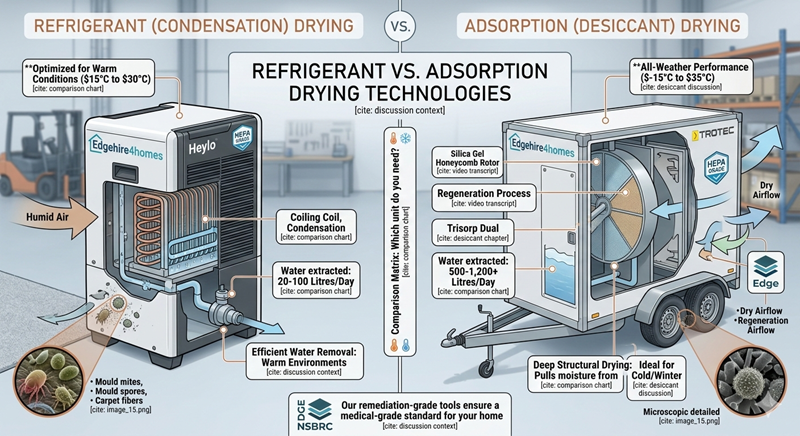
Scenario A represents the most common residential hire at Edgehire4homes. This occurs when a pipe bursts, a washing machine overflows, or a sudden summer storm causes a flash leak while the ambient temperature is warm (typically 15 degrees to 30 degrees)
In these conditions, the air is naturally “thicker” with moisture. Because the air is warm, it holds more water vapor, which can lead to a rapid spike in humidity—the perfect breeding ground for mould in as little as 24 to 48 hours.
When the building is warm, we don’t need the heavy molecular pull of a desiccant trailer. Instead, we use Refrigerant (Condensation) Technology to “wring” the water out of the air as fast as possible.
We deploy units like the Heylo KT 20 or DrizAir 1200.
The Process: The machine pulls the warm, damp air over an internal refrigerated coil. Just like condensation forming on a cold glass of water on a summer day, the moisture in the air turns into liquid water and is pumped away into a drain or sink.
Why it works: In warm temperatures, these units are incredibly energy-efficient, often extracting more “litres per kilowatt” than any other method.
Warm air holds moisture, but it also creates “stagnant pockets” behind furniture or under kitchen units.
The Strategy: We pair the dehumidifier with Air Movers (fans). By keeping the air moving at high velocity, we prevent “boundary layers” from forming. This ensures the dehumidifier is always processing the dampest air in the room, not just the air immediately around the machine.
Warm, wet environments are high-risk for Mould Mites and Aspergillus.
The Edgehire4homes Difference: Even for a simple summer leak, we include a HEPA-Grade Air Scrubber in the setup. This ensures that as the carpets dry, any disturbed spores or dust mites are captured in a medical-grade filter rather than being breathed in by your family.
| Essential Gear | Purpose |
| Heylo KT 20 Dehumidifier | Compact, powerful, and quiet for residential use. |
| High-Velocity Floor Fan | To lift moisture from carpets and floorboards. |
| Edge HEPA Air Scrubber | To maintain medical-grade air quality during drying. |
| Blue Pressure Ducting | To direct dry air into specific damp cupboards or voids. |
In warm weather, if you act within the first 24 hours, you can often save the carpets and floorboards without any permanent damage. If you wait 72 hours, the warmth that makes the dehumidifier work so well also accelerates mould growth, often leading to a much more expensive “Scenario B” style rip-out.
When the building is cold and the water has soaked into the “bones” (concrete slabs, brickwork, and timber joists), we follow this 3-step professional protocol:
In Scenario B, we don’t just dry the air; we have to “pull” the water out of the solids. By using a Desiccant dehumidifier, we create air that is incredibly dry (below 10% Relative Humidity).
The Science: Water always moves from “wet” to “dry.” By making the air “bone-dry,” we create a massive pressure difference that forces moisture out of the centre of a brick and into the air stream.
How does an desiccant dehumidifier work?
If the building is unheated, we often combine the Desiccant unit with Indirect Fired Heaters.
Why? Warm materials release water faster. However, we never use “unvented” gas heaters (like “blue flame” heaters) because they actually produce water vapor as a by-product of combustion, making the problem worse. Our units provide Dry Heat.
In a deep flood, water traps itself in floor voids and behind “dot and dab” plasterboard. We use Axial Fans to “scrub” the boundary layer of air against the walls. This prevents a “micro-climate” of damp air from sitting against the surface, which would otherwise slow down the drying process.
Because the Desiccant process is so powerful, it can actually dry materials too fast if not monitored, which can lead to “case hardening” or cracking in historic timbers.
The additional use of:
Moisture Meters: To track the “Drying Curve” of the actual building material, not just the air.
Remote Monitoring: We can see if the area maintaining the “Desert Dry” status required for deep structural recovery.
| Essential Gear | Purpose |
| Desiccant Dehumidifer | The primary engine for moisture removal in cold temps. |
| Layflat Ducting | To snake dry air into specific “wet zones” or floor voids. |
| H13 HEPA Air Scrubber | To catch mould spores disturbed during the drying of old floods. |
| Moisture Map | A document we create to prove the building is “certified dry” for insurance. |
| Feature | Refrigerant (Condensation) | Adsorption (Desiccant) |
| How it works | Cools air to “wring out” water like a cold soda can. | Uses Silica Gel to “magnetically” pull water from air. |
| Best Temperature | Warm (15 degrees to 30 degrees) | All Temps (-10degrees to 35 degrees) |
| Winter Performance | Poor; coils often freeze up. | Excellent; works perfectly in unheated sites. |
| Drying Depth | Great for “surface” moisture and air. | Deep structural drying (concrete/brickwork). |
| Target Humidity | Typically hits a floor of 40% RH. | Can reach “Desert Dry” (below 10% RH). |
| Common Use | Standard home leaks, summer damp. | Flood recovery, construction, winter projects. |

We specialise in hiring modern, reliable equipment delivered straight to your door, by our people, in our vehicles.